As a PhD candidate at Maastricht University, I investigate how genetic and environmental factors, and their interaction, influence the onset and progression of mental disorders. My work focuses on the psychosis spectrum, in particular psychotic-like experiences such as hallucinations and delusions, which are particularly common in youth (8–17% prevalence). I am interested in developing prediction models using genetic risk scores from distinct psychiatric disorders, as well as indices of accumulated environmental risk.
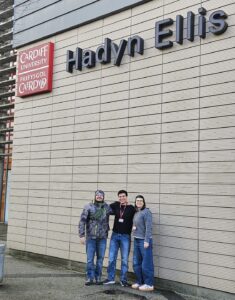
As part of the Youth-GEMs project, I undertook a multi-month research visit to Cardiff, Wales, from November through to February. In this blog, I share my experiences, collaborations, and scientific progress during my time there.
November: Arriving in Cardiff
From the very first weeks, I found myself surrounded by brilliant researchers. The Centre for Neuropsychiatric Genetics and Genomics at Cardiff University is a leading institution advancing research into the genetic aetiology of mental health disorders. Their experience spans genome-wide association studies (GWAS), including the coordination of GWAS for schizophrenia, as well as cutting-edge methods like Genomic Structural Equation Modelling (GenomicSEM), which advances our understanding of the shared and differentiating genetic liability across distinct mental health phenotypes.
I was supervised by Dr. Alex Richards and Prof. Mick O’Donovan from Work Package 4 (WP4), and from day one I was fully integrated into the Psychosis and Major Affective Disorders Group attending lab meetings, department talks, and brainstorming sessions with a wonderful mix of profiles: bioinformaticians, mathematicians/statisticians, and clinicians. These early conversations helped me structure my research plans and understand exactly how I wanted to apply GenomicSEM to my own work.
Cardiff itself genuinely surprised me. I had certain expectations of a medium-sized British city, but Cardiff has a completely distinct character: vibrant student life, a rich historical core anchored by the impressive Cardiff Castle, and the stunning Cardiff Bay.
December: Christmas in Cardiff (and Beyond)
As December arrived, the group organised a Christmas celebration, darts, bowling, karaoke followed by Thait dinner! It was a wonderful way to bond with colleagues outside the lab, and it gave me a real sense of the warmth of the group beyond the science.
My family, partner, and friends also came to visit during this period, and we made the most of it. A standout moment was attending a rugby match between Wales and Argentina. Around Christmas I also made a short escape to London to visit family and soak in the festive atmosphere —crowded, as London always is at that time of year, but still magical.
January: Deep into the Science
After Christmas, I threw myself into the main challenge of my visit: replicating a study that applied GenomicSEM to the psychosis spectrum — specifically to schizophrenia, bipolar disorder, and major depressive disorder. This was a demanding task, but an enormously enriching one. Working through it step by step gave me a solid, hands-on understanding of how to construct and interpret these models.
Alongside this, I also learned to use high-performance computing clusters, in particular the Dutch National Supercomputer (Snellius), to run the computationally heavy analyses that this kind of work requires. Having Alex around to guide me made a real difference.
When not working, I explored more of Wales and the wider region. Swansea was a day trip that had a lot to offer, though the grey skies gave me another reason to plan a return visit in summer. Bristol also left a strong impression, the urban culture, the creative energy, the sheer variety of things to do.
February: Wrapping Up and Looking Ahead
In the final weeks, conversations with my supervisors shifted towards the future: how to extend the GenomicSEM approaches I had learned into gene–environment interaction studies in youth cohorts. A particular focus was the Avon Longitudinal Study of Parents and Children (ALSPAC), a longitudinal cohort with rich, repeated measurements of socio-environmental factors and mental health.
I also participated in the Research Day, which brought together engaging scientific talks, team-building activities, and — importantly — great food!
The visit ended the right way: presenting my GenomicSEM replication findings to the group, agreeing on directions for future work together, and heading to the pub for pints with everyone.
Reflecting on the Experience
This research visit was a life experience. I have long admired the Cardiff group — in fact, before starting my PhD I once applied for an internship there, and due to administrative complications it never came through. Coming back now as a PhD candidate felt like a kind of destiny.
The scientific growth was real and significant. But what I will carry with me just as much are the human connections with the broader group and friends I left there. I hope to see many of them again at the World Congress of Psychiatric Genetics in Glasgow.
A research visit is something I would recommend to any PhD student. Not just for what you learn scientifically, but for everything around it: the new perspectives, the collaborations, and the reminder that our field is built on people who are truly excited to work together.
This article was written by:
Angelo Arias
PhD candidate at Maastricht University