The Youth-GEMs project aims to identify how genes and environment together shape mental health in youth. To do so, researchers use data from large-scale studies which follow developing youth over time, to identify factors which help predict who will develop mental health problems and who won’t.
The field of epigenetics investigates the interplay between genes and the environment by looking at the DNA. In this article, Winni Schalkwijk – a PhD student at the University Medical Centre Utrecht – explains her team’s research into epigenetic biomarkers, and how they can tell us about the role of the immune system in mental health.
What does epigenetics mean?
“Your DNA is like a recipe book for how your body is built up. Each cell contains the same DNA, but it differs per tissue and moment in life how often each recipe is read and used. Epigenetics is an umbrella term for all processes which influence how accessible the DNA code is for being read”, Winni explains.
One of these epigenetic processes is DNA methylation: the attachment of small tags (methyl groups) to the DNA. These tags can hide genes from being read and thereby switch active genes off. As a result, the function of a cell is changed in response to the environment, without changes in the actual digits of the DNA code.
What are epigenetic biomarkers of inflammation?
From a blood sample, researchers can extract DNA from immune cells that circulate in the bloodstream. Has the cell been producing lots of immune messenger molecules? Then the genes encoding those molecules will have been switched on. This is reflected in the pattern of methyl tags attached to the DNA. Winni elaborates: “Since epigenetic patterns such as DNA methylation are quite stable, they can tell us about the long-term activation state of a person’s immune system.”
But how do researchers know where to look in the immensely long DNA code? For this, researchers can derive a biomarker: a sum of epigenetic switches that together link to inflammation in an individual (see Figure 1 below).
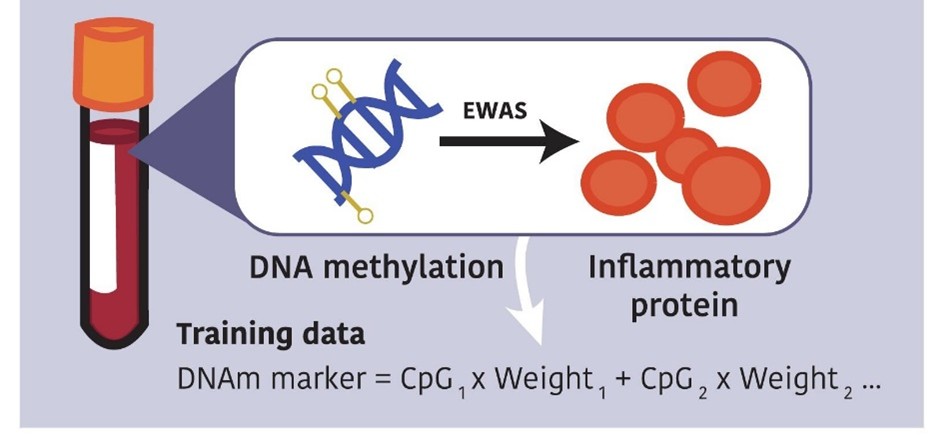
Figure 1 Deriving DNA methylation (DNAm) biomarkers of inflammation.
In a blood sample, researchers look for epigenetic on or off switches upon inflammation. They do so by screening for sites in the DNA (called CpG sites) where they find more methyl groups attached (yellow tags on blue DNA strand) when blood levels of inflammatory proteins are high. This analysis that screens for epigenetic switches is called an epigenome-wide association study (EWAS).
Researchers can perform an EWAS in a large group of individuals to train a DNAm marker: a weighted sum of methylation levels across important CpG sites. This biomarker can then be applied to any group of people with epigenetic data, to investigate relationships between inflammation and mental health.
Why are epigenetic biomarkers of inflammation important for mental health?
Previous research suggests that the immune system is involved in mental health conditions. People who experience mental health problems seem to have higher levels of inflammatory markers than people who don’t. But it is hard to know what comes first: is inflammation the result of mental health problems or can it predict the onset of mental health problems later in life?
“Most studies which follow youth over time have measured single immune messenger molecules, which only capture a small part of the immune response, for one snapshot in time. Epigenetic biomarkers can give richer information about an individual’s immune system over time, which can help uncover long-term relationships with mental health,” Winni explains. In their latest study, she and her team set out to explore what existing research tells us about this topic, contributing to the Youth-GEMs project’s broader aim of understanding how mental health problems develop in youth.
What did the study look into?
The team searched databases of scientific articles to find out what researchers have previously discovered on this topic. They first looked for studies on which DNA methylation switches relate to inflammation, to create an overview of epigenetic biomarkers of inflammation that are currently available. Then, they searched for studies which used such biomarkers to study how inflammation is related to mental health.
What were the main findings?
The team found 29 articles which identified DNA methylation patterns related to inflammation. Then, the team found 14 studies which examined epigenetic biomarkers of inflammation in relation to mental health (e.g. depression) or other outcomes relevant to mental health, including cognition (e.g. memory or processing speed) and brain structure measured with brain imaging (e.g. volumes of specific brain areas).
Winni summarises the results: “Studies using epigenetic biomarkers reported that inflammation was related to reduced cognitive function, lower brain volumes and reduced integrity of white matter, which are the connections between brain cells.”
Findings for mental health were less clear. “Studies reported either that higher inflammation was related to more mental health problems or did not find any association between the two.” The team noticed that most studies focused on depression, while only a few studies examined other outcomes such as psychotic experiences or ADHD. The age at measurement varied strongly, making the findings hard to compare.
What does it mean for the future?
These findings suggest that epigenetic biomarkers offer a promising tool for studying how the immune system is involved in brain health and mental health, but more research is needed. The team has several ideas to bring this research field further, shown in Figure 2.
“If epigenetic biomarkers can help better understand how the immune system is involved in mental health, these insights can ultimately be used to improve prevention and treatment strategies, supporting both body and mind to boost resilience in youth.”
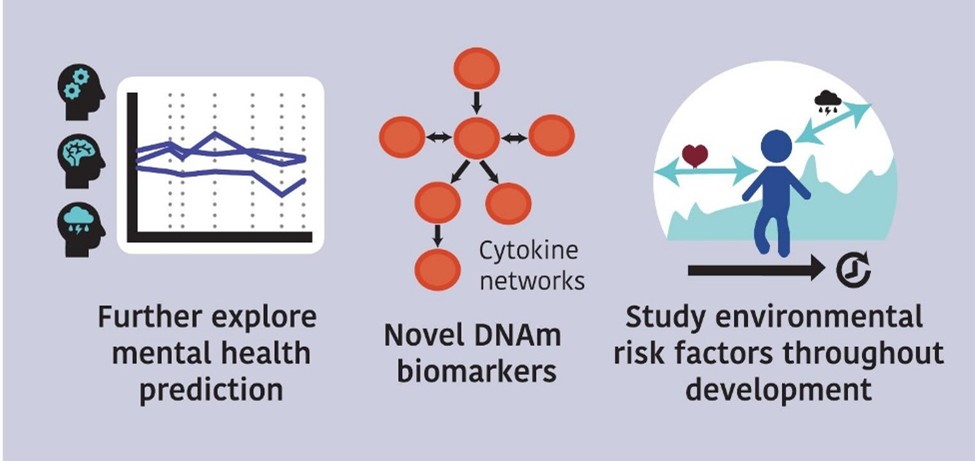
Figure 2 Recommendations for future research. Further explore mental health prediction by evaluating a wider range of epigenetic biomarkers and mental health outcomes. Develop novel DNAm biomarkers using larger and richer datasets. Study environmental risk factors throughout development to understand how the immune system responds to the environment in which youth grow up.
Read the full article 👉 Epigenetic biomarkers of inflammation in studies on mental health: Current applications, limitations, and future directions – ScienceDirect
This article was written by:

Winni Schalkwijk
PhD student at University Medical Centre Utrecht