New scientific study: Interpersonal stress, epigenetic indices of inflammation, and depressive symptoms
- September 2, 2026
In the Youth-GEMs project, researchers follow developing youth over time to identify factors which help predict who will develop mental health problems and who won’t. In this article, Winni Schalkwijk —a PhD student at the University Medical Centre Utrecht— explains her team’s latest research into the link between stress, the immune system and symptoms of low mood, which can be an early indicator of depression.
What did the study look into?
When adolescents experience psychological stress in their relationships with parents and peers, this can contribute to symptoms of low mood both during adolescence and into adulthood. However, we still don’t fully understand what happens in the body that might explain this link. The team investigated whether the immune system plays a role. “Whereas a short burst of stress typically suppresses the immune system to help preserve energy”, Winni explains, “continued psychological stress disrupts how immune cells respond to stress hormones”. This can result in chronic, low-grade inflammation, meaning that the immune system remains slightly activated over a longer period of time.
Previous studies in young people have linked signs of inflammation in adolescence to an increased risk of depression later in life. Therefore, the team investigated whether inflammation can be one way for how interpersonal stress in adolescence contributes to depressive symptoms in young adulthood.
Who participated in the study and what was measured?
The team used data from 497 Dutch young people, who participated in yearly assessments from the age of 13 to 17, followed up by once every two years in adulthood. In these assessments, participants answered questions about how they experience the relationships with their parents and peers, as well as their mental health. Additionally, some participants provided saliva samples at the ages of 17 and 25. From the cells present in these saliva samples, the team extracted DNA and measured epigenetic patterns: changes to the DNA that affect how genes work without changing the genetic code itself. The researchers looked at patterns that previous studies have linked to chronic low-grade inflammation.
The figure below shows the study design of what was measured at what age.
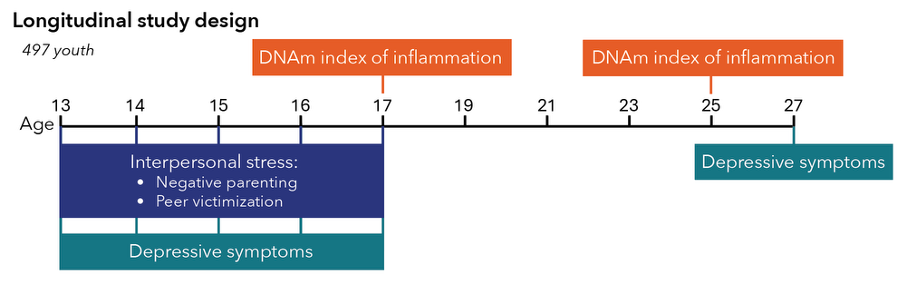
Figure: Study design
An epigenetic index of chronic low-grade inflammation
Prior studies have measured signaling molecules in the blood that are signs of inflammation. A key example of this is c-reactive protein (CRP), a protein produced by the liver in response to inflammation. CRP concentrations in the blood can increase dramatically (up to a thousand-fold) during acute inflammation, for example during a bacterial infection. CRP can also be a good indicator of chronic low-grade inflammation, but recent studies suggest that epigenetic patterns can even capture this better. “Epigenetic patterns on the DNA provide a relatively stable record of how activated immune cells have been over time”, Winni elaborates. Another advantage is that epigenetic patterns can be measured from saliva when blood samples are not available, as is often the case in studies involving children.
What were the main findings?
The results were different from what the team expected. Overall, neither stress in relationships during adolescence nor the epigenetic measures of inflammation were linked to depressive symptoms in young adulthood. When the researchers looked more closely at the source of stress, they found that stress adolescents experience in the relationship with their parents was linked to higher inflammation at age 17. They did not find the same link for stressful relationships with peers. Winni notes: “This suggests that different types of stressors can have different effects on immune activation, reflected in epigenetic indices from saliva, which could be worth following up in future research”.
Conclusion and future directions
Overall, the study did not find evidence that inflammation caused by stress in relationships increases the risk of depressive symptoms later in life. “Maybe inflammation is indeed not a mechanism linking interpersonal stress to low mood, but one study cannot fully answer this question. There is still much to be learned about epigenetic indices of inflammation, and our study illustrates that these markers can provide new insights into stress responses and mental health”.
Final note: interdisciplinary collaboration makes for great science!
This study connects developmental psychology to molecular biology, from which both the researchers and science benefit. Winni reflects: “I have learned so much from Stefanos Mastrotheodoros on this project. With his expertise on developmental psychology and my background in molecular biology we could truly create something better by working together”. Often, mental health and physical health are studied as two separate entities. “To understand the complex interactions between our environment, our body, and our mind, collaboration across disciplines is key.”
Read the full article here: https://www.sciencedirect.com/science/article/pii/S2352289526000548?via%3Dihub

Winni Schalkwijk
PhD student at University Medical Centre Utrecht